Showing posts with label Ohio. Show all posts

Thursday, February 22, 2024

Special places to Grandma and Grandad White in Ohio

 Here is a list of places important to Grandma Kathleen and Granddad Jerry in Ohio, in their own words:

Amelia.  Population was 550 when we were growing up.  No traffic signals, Rte 125 was a two lane road until 1951.  HS basketball games were the major social event.  Places of interest:
  • Wallace Music Shop.  Grandma's home.  Where her dad sold and repaired musical instruments.  Later run by your great aunt Janet.
  • Little green house next door to the West.  Owned by the Wallaces, where Janet lived, after her marriage,until she moved into the Music Shop.
  • White Acres.  156 acres.  I think it is now all homes, it's called Quail Creek, except for a small commercial area on Main St.  Big house with really high ceilings, a grand staircase.  Other buildings.  Two barns, one for horses, one for cows.  Groom's House.  Combined 3 car garage, tobacco stripping shed and hired hand's two tiny rooms, and a two-hole outhouse.  Tenant house next door (It once caught on fire) and another tenant house about 3/4 of a mile back from the road.  A long walk to a highway.  The tenant house was later moved to front on 125.

White Acres House


  • Amelia Elementary School.  This was the HS in our time, our elementary school building was torn down.  You might be interested in how small the school was.  Also the gym where Granddad was the hero in two straight basketball games where we won by three and one points to keep our home streak winning alive at 46 and 47 games.  He scored the winning points in the last 30 and 5 seconds respectively.  He was carried around on shoulders after the last game.  Ex girl friend cheer leader kissed him and professed her love while Grandma looked on.  NOTE: Both Grandma and Granddad walked to school.  See how close they lived to each other.
  • Wallace Restaurant.  About a block in distance to the west of the Wallace Music shop (where the old CG&P railroad crossed 125).  Was next to a gas station, while the lumber yards were across the street.  NOTE:  CG&P stood for Cincinnati, Georgetown and Portsmouth.  But the railroad never got past Georgetown.  Ran through White Acres.  Granddad remembers seeing the cars.  Abandoned circa 1940.  When the road was abandoned the ties and rails were removed.  The railroad fill was used by White Acres to get across a small stream.  Prior to that we had to go through the stream.  There were times our truck got stuck and had to be pulled out by our horses.  NOTE: Granddad was driving the tractor across the fill when he lost his steering.  The tractor went over the side and started to tip over when the front wheel got to the bottom of the fill and the tractor righted itself.  He was really scared.
  • Granddad's best friend, Jack Francis, lived on Cleveland Lane.  Granda and his brother Jock occasionally rode work horses to get there.  We took the back route through our farm.  Usually Jack picked us up on his bike.  I rode on the crossbar, Jock on the carrier on the rear.
  • Coffey's store.  A few homes east of grandma's house.  Doug and Peg went there for candy when we stopped at Granny and Gramp's house on Main Street after they moved from White Acres.
  • New Richmond, Ohio.  Granny and Gramp lived on Front St. before moving to White Acres.  The last we knew the big homes were still there.  It was a great view of the Ohio River.  Granddad had relatives there when he was growing up.  Great view of the river and towboats moving along.  There was a ferry that White Acres horse truck used to get across to fairs at Germantown and Alexandria.  Later the ferry closed at 6PM.  Once our family was going to Clermont County from Frankfort and we tore along the roads to get there in time.  However we were just a little late getting there.  We raced down the drive blowing our horn.  Thankfully the pilot was a nice guy and came back and picked us up.  Otherwise we would have had an extra two hours drive.  NOTE:  The Ohio used to flood enough every few years that the homes on Front St were flooded.  Granny said the secret to the clean up was to sweep out the water and mud as the water level dropped below the level of the floor.
  • Ohio River.  That was our primary place to water ski.  Initially we were at Varnholdt's marina on Front St.  There was about twice the difference in elevation compared to our Lake Anna home.  It was all steps.  Granny Jo and her boys used to camp in pup tents on a deserted beach at Point Pleasant.  We tubed, especially when a big stern wheeler went by.  There used to be a Dam just below New Richmond.  However it was eliminated and the water level is now higher eliminating almost all the beaches we used to visit.
  • Coney Island.  Entrance at Kellogg Ave and Three Mile Road.  Really clean.  It was the big amusement park in southwestern Ohio.  Where your Great Uncle Cecil played in Clyde Trask's band at Moonlight Gardens.  He made a lot of money as a teenager.  Coney had at the time the largest swimming pool in the world with circulating water.  There were three coasters plus a very steep descent in a boat on Lost River.  There were a lot of other rides.  Than Coney developed King's Island and closed just about everything but the pool.  Since then they reopened some rides; how many we do not know.
  • FYI.  The Island Queen used to transport passengers from the foot of Broadway to Coney.  It also made trips to places like New Orleans and Pittsburg.  There was a huge dance floor and Trask's band played on the Queen.  While tied up in Pittsburg, Cecil was watching a welder when he decide to go uptown.  The Queen blew up just a little after he left the boat.  Probably caused by the welder .  Coney opened up for orphans once a year before opening to the public.  They would board at Broadway and ride the Queen both ways.  Rides were free.  Granddad's Aunt Marie worked with the orphans.  So Jerry joined in with the orphans for their ride on the Queen and Coney's rides.  Granddad and his friends spent a fair amount of time at Sunlight Pool.  Coney is on US 52, just up from the Circle Freeway.
  • TP White Funeral home.  TP White originally had funeral homes in New Richmond and Mt. Washington.  AS TP passed the homes on to his sons, the ultimate result is the MT. Washington home was owned and operated by the Croxtons and the New Richmond one by Sumner Powers.  He later opened a 2nd funeral home in Amelia.
  • Clermont County Fairgrounds in Owensville.  The County Fair ran almost a whole week.  Granddad Cliff was on the Fair Board until he moved away and he was replaced by Granny Jo.  Granny Jo was always the Secretary of the Horse Show.  Granddad used to be at the fair every day it was open.  He got to sit in the Judges stand by the announcer.  While White Acres showed Registered Saddle Horses, he always liked the Hunter and Jumper classes best.
  • We have no knowledge of the house Frank Gruppenhoff built, nor where Granddad Cecil studied music.

Sunday, September 19, 2021

How Grandma Lucy broke her nose

Here's an excerpt from story time with Grandma Kathleen. I love her unique style of telling a story and her expressive use of pauses.


While we’re talking about broken noses, I have a story about Grandma Lucy.

She broke her nose! This was way back, the roads weren’t paved. She lived on a gravel road. She drove an old, old car, and this was back in the 30s, I guess.

Anyhow, she was out on this dirt road, and I don’t remember if the car turned over or something, but she had a wreck. And broke her nose! The lady that lived at the house in front of where she had this wreck, came out--

“Oh Lucy!”

went back in the house and came back with a mirror. Mom’s nose: smashed all the way over.

Mom took a look at the mirror, straightened her nose back up again. And she did go into the hosp--not the hospital, back in those days you didn’t have a hospital around, anyhow, went in to the doctor, and the doctor said, it’s a good thing you did what you did. Because of course now it was all swollen and the doctor couldn’t do anything about it. But she had placed it, and yeah, she had a little bit of a crooked nose, it was okay, the passages worked okay, but anyway, it was a pretty neat story. I believe that my older brother was just a little baby in the car at the time.


You can see in these two pictures, her nose looks perfectly straight! Click the picture to zoom in.


Granddad Jerry on being smaller than most of his friends

Here's an excerpt from story time with Granddad Jerry:


What would you do to hold your own against bigger kids?

Well in the first place, we were at White Acres. We had the barn, the yards, we could play football in the front yard, baseball in the side yard, we had the barn we could play basketball in, we could play Catcher in the Mow and whatnot, and so that’s where all the neighborhood kids came. I mean, back in those days, Amelia had a real mixture of sort of elite, to right down to the very bottom, drunks and whatnot. And I’m afraid that the language of the lower classes took over for us. I mean, there was one point along the way where I remember thinking, “y’know, all this cursing isn’t right, I can do better’n this.” And I stopped pretty quickly. 

We were a bunch of hoodlums. They were all older. I mean nowadays, I think parents and everybody would go crazy to see how we were left alone. And these kids came up to play at our place, and they just showed up by themselves on their bike or whatever to join in the games. They came because we had the big yard.That’s where the kids always came. I guess when I was about 7 or 8 we were playing Kick the Can and Wolf and stuff like that. And our place was just the place where everybody came. But when you’re the smallest guy, you don’t want anyone taking advantage of you. So I was always playing with bigger kids. I never felt bullied by anybody.


I remember everybody else could climb up to the rafters and they could reach up to the top, and their feet would touch the bottom. But when I’d climb up on the rafter I couldn’t reach to the top, so if I was going to climb up on a rafter playing Catchers, I’d have to go to the second level or whatnot and go up to the top of the barn. But I was always the smallest. But like Kathleen said, I had the football. And 5th and 6th graders would play, and I was a 3rd grader when I started to play, but I had a helmet on, no one else had a helmet on. And I always played safety, and a guy’d come running down the field by himself, I’d go over and hit him in the legs, knock him down, other times, I’d be hanging on and he’d be dragging me along, then somebody else would come up and hit ‘em. I was the only kid who got to play up like that.


G’ma: Not only did you have the ball, you also had the barn and the whole farm to run on. You had a good place.

G’dad: I guess I thought most of the kids my age were kinda wimps or something.


I never thought about it [all the others being bigger]. They were the guys I played with and they were always older than me. When I was at school, I was always playing with the older kids. And I was sorta the leader of the younger kids. I say younger kids, I mean kids in my class. But I never played with them for a long time. My best friend was Jack Francis, he was center on the basketball team, but he was always like a foot taller’n me. I never thought of him as--I knew he was bigger’n me--but I never thought of him as tall. I’ve seen some movies, pictures later and thought, “he was that much taller than me?” But I never felt handicapped because I was short, except that I couldn’t reach, and I couldn’t jump and I couldn’t --wasn’t as fast or as big as the other people, but I never felt short. But the girls that I dated, the shortest was probably about 4’11, and the tallest was probably like 5’10 or 5’11. I was 5’5 ½. It never bothered me. If they didn’t want to go out with me because I was short, I figured that they would tell me.

Tuesday, March 30, 2021

Valentine's day in Cincinnati, circa 1953

For the longest time, I thought I had the stereotypical sweet grandmother, the kind who gave her grandchildren unlimited sweets and never yelled, and was perfectly sweet and kind in every way. To be fair, I never heard Grandma Kathleen yell (even when she was upset!) and my siblings and I were always delighted by the amount of sweets and other treats we got while we were at her house. Grandma made visiting her home truly magical for us kids.

When we would talk about it with her as adults, she would say, "Well, you don't know; I'm not actually all sugar and spice!" We didn't believe her, even after she told us about devious plans that she'd come up with in the past--that never came to pass.

Until ONE day, we found out that she sent mean Valentine's to Granddad and his roommates!

Grandma was living at the YWCA in Cincinnati, and Granddad was attending the University of Cincinnati. They were living close enough that they could see each other. Granddad says that Grandma even came over at one point and cooked a meal for everyone to share.

Jerry (1951), Kathleen (1952)

Grandma had a brilliant idea. Months in advance, she prepared cards to send to Granddad and each of his roommates, and sent them home with her roommates during Christmastime. Why, you may ask? To throw them off the scent! Each of Grandma's roommates sent the card from her own hometown.

So when mean Valentine's cards started arriving for Granddad and his roommates from seemingly unrelated places in Ohio and Indiana, Granddad and his roommates were perplexed. 

When retelling the story, Granddad said, "The cards started out with something that looked nice and then got right nasty when you opened them up."

Granddad received this one "signed" by his cousin and roommate, Dave Grupenhoff:


Me thinketh

Thee stinketh


Another one that came in, also "signed" by the roommate of the recipient:


I would climb the highest mountain

I would swim the deepest sea

just to get 

away from thee.


I can imagine Granddad and his roommates' confusion, and Grandma struggling to keep a straight face while he tells her the riddle of the mean Valentine's cards. "How could this be happening?" Granddad and his roommates must have wondered out loud.

Granddad reminisced, "When the culprit finally confessed, we all could imagine she and her friends just sitting around and laughing at our confusion." 

He and Grandma both get a good laugh out of it now.


Thursday, January 16, 2014

Ellen Eve Rowe

Parents: James Rowe, Mary Ann Mitchell
Birth: October 16, 1851 in Shropshire, England
Year of immigration to US: 1860/1861 Year of naturalization 1871
Marriage: Jun 11, 1872 to Wheelock Winspear. They had six children: John Burrige, Wheelock William, Minnie May, Nellie Grace, Marie Mabel, and Catherine Pearl
Death: January 16, 1948 in Ohio, United States

Ellen was born in Shropshire, England, and was the second child born to James Rowe and Mary Mitchell. When she was about 9 years old, Ellen left England and came to the United States to live with John and Lydia Burrige, who had no children of their own. I believe that John and Lydia were Ellen's aunt and uncle, because according to Lydia's death certificate, her maiden name was Rowe.

Dad wrote a note on James Rowe (Ellen's father)'s page in Family Search. It says:
"James & Wife Mary Ann & 3 children died in epidemic. William and Ellen were then raised by the Burriges."
So it appears that Ellen was an orphan, although an orphan that loved her foster parents very much.  She was only 8 or 9 when she made the journey across the ocean to the United States, so she had plenty of time to get close to them before she married. She also named her first born son after her foster father John. Her son Wheelock William was obviously named for his father, but perhaps his middle name was in memory of Ellen's brother William.

Three names from Ellen's family are in my family: Mary Ann (Ellen's mother), Ellen, and Catherine (Ellen's daughter; also Ellen's mother-in-law). I don't know if it was intentional or accidental that my parents gave us names from our family heritage; I remember hearing once that I was named for someone in our family tree, but when I've asked about it more recently, I was told otherwise.

Anyway, Ellen was living with John Burrige and Lydia Burrige in 1870 (see the census below). They had emigrated from England about 10 years before Ellen had, and I imagine that they were well established in their Ohio township, Clermont County community by the time she reached them in 1860. Ellen married Wheelock Winspear just two years after the census was taken, when she was 21.

The two started their family, lived in Kentucky for a while (where their son John was born), and then settled in Pierce Township, Clermont co, Ohio. The place they settled was probably on Wheelock's family farm, since Wheelock's mother (Kate) and spinster sister (Maria) were living either with or right next door to the young family.

As the years progressed, Ellen and Wheelock's sons and daughters were married. The aging couple stayed in Pierce, Ohio until they moved to Ohio, Ohio (seriously, that's what it's called!) one township over.

Ellen's foster mother Lydia Burrige passed away in 1918, probably around or close to the time that the Winspears moved to Ohio twp. Since her foster father John had already passed on, Ellen was the informant for the death record. She either knew or had records for Lydia's birth date and father's name, which were recorded on the death record.

1924 was a difficult year for the Winspear family. On New Year's Eve, (Dec 30, 1923), Ellen and Wheelock's son John died. Just a few months later, in May, Wheelock passed on from acute nephritis (kidney disease), and then in June of the same year Ellen and Wheelock's son Wheelock William passed on also.

Thankfully, Wheelock Winspear had provided well for his widow--they owned their house in Ohio, Ohio--so Ellen would not face as much financial difficulty as another might in her situation. Wheelock was already 77 at the time of his passing, and I believe the two were both prepared for it. However, no matter how much you know what's coming, loss is hard to bear; I'm sure it was even harder for Ellen to bear since two of her children in addition to her husband passed away all in one year

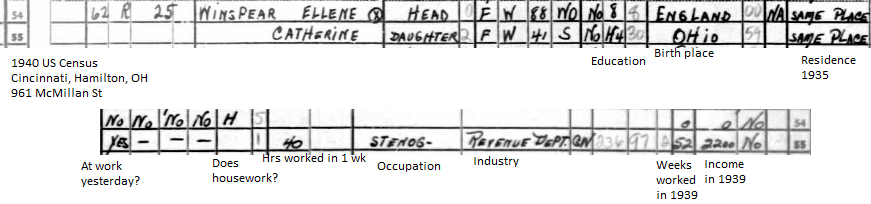
Even though the house was owned free of mortgage, Ellen did not want to live by herself. By 1930, she was living with her daughter Catherine in Cincinnati in a place they rented for $35.00/month at 961 McMillan St. I imagine she sold the house in Ohio twp and used the money from the sale to supplement Catherine's income as a clerk at the post office. In 1940, Ellen still lived with Catherine at the same address. The view from their window probably included this building: 

Picture from Google Street View, 978 McMillan St, Cincinnati, OH
The building that they lived in has been torn down, and a Kroger grocery store sits in its place.

In 1940, Catherine worked as a stenographer at the Revenue Department. Since neither the 1930 or 1940 censuses list an occupation for Ellen, I believe she just stayed at home to keep house and cook their meals. At some point between 1940 and 1948, Catherine had married a Mr. Barnhart and moved to Waynesville, Warren county, Ohio (northeast of Cincinnati). Ellen came with them, and passed away in Waynesville in 1948 at the ripe old age of 96.


Marriage record:
1870 Census

1880 Census

1900 Census:

1910 Census:

1920 Census:


1930 Census:

1940 Census:

Death record (1948)


Monday, December 16, 2013

Wheelock Winspear

Parents: John Winspear, Catherine Almira Wheelock
Birth: March 8, 1847
Marriage: June 11, 1872 to Ellen Eve Rowe. He was 25 and she was 20. They had six children: John Burrige, Wheelock William, Minnie May, Nellie Grace, Marie Mabel, and Catherine Pearl.
Death: May 27, 1924, at 77 years old

Wheelock was born in New York State near Buffalo. He was named by the maiden name of his mother. For at least the first 13 years of his life, his family lived close to his mother's family in Lancaster, Erie County, New York, as you can see from the 1850 and 1860 Censuses. His family farmed and had boarders, and even a servant at one point.

For some reason or another, the family decided to move from NY to southern Ohio, 450 miles away from where they used to live. The place they settled on was a small town called Pierce, a mere 3.5 miles from Amelia, and about the same distance from the Ohio river, which was also the Kentucky-Ohio border. They probably moved around 1868 or 1869, since Wheelock's 2-year-old niece Girtie was born in NY and his 11-month old niece Maude was born in Ohio. The girls and their parents were living with Wheelock's parents at the time of the 1870 US Census.

In 1872, Wheelock married his life-long companion, Ellen Rowe. Their first child--John--was born across the river in Kentucky, but the rest of their children were born in Ohio. I'm guessing that Wheelock had found a temporary job in KY to help him get his new family on their feet, and then moved back to Ohio to be close to his family once again.

In 1880, Wheelock's mother and youngest sister were living with or right next to his own young family. He had 3 children, including Minnie May (recorded as Minetta on the census). The farm was doing well enough that he could employ a man to help on the farm.

As the years progressed, Wheelock's sons and his daughters were married. He and his wife Ellen stayed in Pierce, Ohio until they moved to Ohio, Ohio (seriously, that's what it's called!) one township over a few years before Wheelock's passing in 1924.

1924 was a difficult year for the Winspear family. On New Year's Eve, (Dec 30, 1923), Wheelock's son John died. Just a few months later, in May, Wheelock passed on from acute nephritis (kidney disease), and then in June of the same year Wheelock's son Wheelock William passed on also.

Thankfully, Wheelock Winspear had provided well for his widow, and they owned their house in Ohio, Ohio, so she would not face as much financial difficulty as another might in her situation. Wheelock was already 77 at the time of his passing, and I believe he was prepared for it.


Sources:

1850 Census:

1855 New York State Census:


1860 still in Lancaster, New York

1870 US Census


Marriage record:


1880 US Census:
1880 Census, Pierce, Clermont, Ohio

1900 US Census:


1910 US Census

1920 US Census

Death Certificate


Thursday, October 10, 2013

Frank Henry Grupenhoff

Frank was a trunk maker, a home owner, and a single parent. He buried two children and his wife within seven years of each other. He lived through the Great Depression and both WWI and WWII. He must have had some kind of staying power. What a man!

According to a book written by my sister when she was in elementary school, Frank's family was the first in their neighborhood to get a car. Her source was probably our father.

Parents: Frank Grupenhoff, Mary or Maria K. Wissing
Birth: April 12, 1874
Marriage: October 29, 1902 to Josephine Plogsted. He was 28 and she was 20. They had six children: Cecilia, Edward H, Rosella Marie, William B, Clara A, and Josephine Agnes
Death: March 23, 1953, aged 78 years

1880 Census - Frank was 6. At this point, he was in a single-parent family, as his father had died when Frank was only 3. Mary, Frank's maternal grandmother, was also living with his mother, his sister Clara, and Frank himself. Frank and Clara were the youngest of their siblings, and their older siblings Henry and William are not listed on this census. I wonder if family members had taken the older siblings to lighten the financial burden from Frank's mother? Well, what I do know is that later, Frank's older brother William was living with his mother.

1899 City directory of Cincinnati. He was living at the same address (531 Woodward) as his mother Mary, brothers William and Henry, and sister Clara. William is listed as a porter, Henry as a varnisher, Frank as a trunk maker, and Clara as a cigar maker. If you'd like to see the directory, send me an e-mail. Someone else helped me find it, and I believe it would infringe copyright to post it here.

I couldn't find Frank in the 1900 census, although I found his mother, brother William, and sister Clara at the same address as in the directory. They were renting there, and at least five other families lived at the same address, so I'm guessing that they lived in an apartment building. The address listed on his marriage license is different from the one he lived at in 1899, so it's possible that he moved to the address listed on his marriage record between the compilations of the directory and the census. Frank was 26.

Marriage License, 1902:

The addresses listed for Frank and Josephine on this marriage license are very close to each other--not even half a mile apart! I'm sure they met because of their proximity to each other. Frank was 28 at the time of his marriage. I wonder why he waited so long (for that time period) to marry? Was he focusing on supporting his mother? Was he searching for love? Was he working on becoming financially stable? Whatever the case, he and Josephine Plogsted were married by a Catholic priest in October of 1902 and started their family immediately. 1903 brought Cecilia, Edwin came in 1904, Rosella in 1906, William in 1907, Clara in 1909, and Josephine Agnes (Granny Jo!) in 1910. By the 1910 census, the family had purchased a small home on Bouton Avenue and were working on paying it off. Frank must have been successful in his profession of trunk maker to make such an investment.

1910 Census:

The decade between 1910 and 1920 brought much sorrow to Frank's life. His daughter Clara died from severe burns she received in an accident, WWI started, his daughter Rosella died of diphtheria, and finally, his wife passed away from heart failure. See the post on Frank's wife Josephine for more detailed information on the three deaths.

After his wife died, Frank's mother came to live with him, I'm guessing to help with the children. It's possible that she came to receive the support of her son in her old age, but I find that doubtful since Frank was recently widowed and at the time of her death, Mary was living with her son William (see the addresses on her death certificate). The draft registration lists details that we already know but also has a physical description: Frank was average height and weight, had gray eyes and "light" hair.

Death certificate for his daughter Clara (1912)
1914 WWI starts
Death certificate for his daughter Rosella (1915)
WWI Draft Registration. (1918)
Death certificate for his wife Josephine (1919)

1920 Census:
In the 1930 census, Frank is listed as a carpenter in the home building industry instead of as a trunk maker. Cecilia was staying at home to take care of the house, Edwin worked as a production man (whatever that means--maybe it's a precursor to engineering?) in the soap industry, and William worked as a clerk for a roofing company. The census notes that Frank's family did not have a radio at this point, even though his daughter Jo and her new husband Cliff already had one.

Jo was the first of Frank's children to marry (in 1929), and his children Cecilia and Edwin married soon after. William took a little bit longer (according to information done by other researchers), but was not living with Frank for the 1940 census anyway. William was a grown man of 30-something by this point, so I'm not surprised. Frank lived in the house at Bouton Ave up through the 1940 census, but decided to move to Woodward St sometime before 1953.

1928 Mary Wissing mother of Frank passes away.
1929 Josephine Agnes Grupenhoff (Jo) and Clifford Winspear White's marriage
1929 The Great Depression
1930 Census
1939 WWII
1940 Census

Death certificate (1953): Frank died of "Chronic myocarditis" -- in other words, chronic heart problems. He had moved to 217 Woodward St., Cincinnati, Ohio, and was living there at the time of his death. His mother is listed as living (renting) at 531 Woodward in the 1899 Cincinnati directory, and Google maps shows these two addresses as right next to each other.

Monday, October 7, 2013

Josephine Plogsted

Parents: Frederich Henrich (Henry) Plogsted, Marie (Mary) Appleman
Birth date: September 14, 1882 (September 25, 1882 according to death certificate)
Marriage: October 29, 1902 in Cincinnati, Ohio, to Frank Grupenhoff. Josephine was 20 and Frank was 28. They had six children: Cecilia, Edward H, Rosella Marie, William B, Clara A, and Josephine Agnes.
Death date: March 29, 1919, at age 36

The earliest record I was able to find for Josephine was the 1900 census. She was 17 when it was taken, and from it, you can see that her parents were both born in Germany, had been living in the US for 32 years each, and were naturalized citizens of the US. They rented a house on Colerain Avenue in the city of Cincinnati, and young Josephine worked as a dressmaker. At least half of the families listed on the same page as the Plogsteds were also immigrants, mostly from Germany.

Soon after this small glimpse we get into her life, she married Frank Grupenhoff, also a son of German immigrants. At the time, she was still working as a dressmaker, and from the marriage record, we see that they were married by the Reverend J. M. Felden, a Catholic priest. Josephine was still living at Colerain Avenue -- she was living at 3661 Colerain Avenue, to be exact. That address is in the middle of a street now!

It appears that Josephine spent the rest of her life at a cute little house at 4940 Bouton Street, Cincinnati, Ohio. She and her husband Frank were there for the 1910 census, and it is the address on her death certificate. I found a picture of the house on Google Maps Streetview. Look!

Image from street view on Google Maps
When you look at the house with satellite view, you can see the roof over the porch and room next to the porch is flat. I don't know if these were additions after the Grupenhoff family moved out, but I can just picture Josephine's children playing on the porch and climbing out of the windows to sit on the roof when they could get away with it.

Unfortunately, Josephine had to experience the tragedy of two of her children passing away before she did. Clara, the second youngest, died in 1912 from shock she experienced after receiving severe burns. Her death certificate lists "Shock [for?] multiple burns accidentally received (set fire to clothing with lighter match)" as the cause of death, but family lore says she and the other children were playing by a brush fire and her dress caught fire as she tried to jump over it like the other children (source: my dad). She was only three years old. I can't imagine the agony that Josephine must have felt, and I wonder if she blamed herself for not watching the children more closely.

Rosella Marie, the third oldest, died just three years later of diphtheria, a bacterial infection that is now essentially eradicated in industrialized nations because of vaccines. The doctor visited two days before Rosella passed on, but evidently there was nothing he could do, because she passed away on September 16, 1915. Rosella was only 9 years old. (I had to do some digging to find Rosella Marie's death certificate, and I had a really neat experience after I found it that I wrote about here.)

Josephine Plogsted passed away in 1919 at age 36 of heart failure or "acute myocardial insufficiency," according to the death certificate, and the secondary cause was asthma. She had been doing poorly for at least two days--and probably more--before her death, because the death certificate shows that she had been attended by a physician two days before her passing. Her oldest child Cecilia was only 15, and her youngest--my Granny Jo--was only 9 years old when they lost their mother.


Sources:

1900 Census:
1900 Census
Marriage license (1902):
Marriage license, 1902
1910 Census:
1910 US Ohio Census
1920 Census (to give an idea of where her family was when Josephine passed on):
1920 US Ohio Census

Thursday, June 13, 2013

James William Wallace


Julia Anna Peters, James W Wallace
Parents: Daniel Wallace, Eliza Kennedy
Birth: March 21, 1867
Marriages:
  1. October 31, 1896 to Julia A. Jordan. Julia Jordan was about 20 and James was 29.
  2. August 20, 1899 to Julia Anna Peters. James was 32 and Anna was 26. They had two children, Adrian Floyd and Cecil Denver.
Death: December 20, 1944. James was 77 years old.

James grew up and lived in and around Green, Brown, Ohio. That combination of township and county makes me laugh every time! I think there might have been some Whites that lived in Green, Brown, Ohio, too. Oh, so many colors.

ANYway. The 1870 and 1880 censuses show that James grew up with both sets of grandparents, and many of his aunts, uncles and cousins living right next door or down the road from him. Isn't that great? I'm guessing that they all helped each other with their farms and such. I wish I could post a picture of the census with everybody labeled according to how they're related to him (James), but I recently found out that it might not be allowed to post pictures of records from Family Search on the internet, so I'm waiting to hear back on if I have permission. If I don't, I'll be taking down all the record images that I've posted on the blog. The links will still be there, though.

James was the oldest of three boys. His father passed away when he was young, so James's mother had to raise her children on her own. I'm sure having all that family around made a big difference to her, but even with all of his uncles and family around, I wonder if James felt responsible to fill the role of his father in providing for his family, as he was the oldest son?

James was very close to his family on both his father's and his mother's sides. Most of his relatives that lived on land adjacent to his immediate family were Wallaces. I also found two 1880 censuses recording a James Wallace of the appropriate age. One was listed with Elizabeth Wallace (James's mother) and the other was listed with Z. H. Kennady -- or Zedick Hezekiah Kennedy -- Elizabeth's younger brother and James's uncle. On the census, it shows that James was working on the farm, so I think he must have gone to help his uncle out with some of the farm work when the census was taken.

I did find a marriage record for a Julia Jordan (NOT to be confused with Julia Anna Peters!) and a J. W. Wallace. A John Wallace was witness that James and Julia were old enough to marry without their parents' consent and that they weren't too closely related. I'm guessing that this John was James's younger brother. This marriage took place in Clermont County, Ohio, very close to where James grew up. I couldn't find any other records pertaining to Julia Jordan after she and James married, but I think someone has because there's a death date for her on Family Search.

I was unable to find a marriage record for James and Julia Anna Peters, but documents pertaining to their two children (a birth record for Cecil Denver and a marriage record for Adrian) list James Wallace and Julia Peters as their parents. Mabel Shell, Anna Peters's daughter from her first marriage, lived with them until she either married or was of age to move out. I wonder what James's relationship was like with her?

By the 1900 US Census, Mabel is 4 years old and James and Annie had been married for about a year. They were renting a house that didn't have a farm, but most of the people living near them lived on farms.

At the 1910 Census, James and Annie seem to have a really good life going for them. They own their own farm free of mortgage! Their children are growing and going to school--at this point, they have two boys (Adrian, 9, and Cecil, 1.5 years - here's his birth record from 1908) in addition to Annie's daughter Mabel. James seems to have steady work at the sawmill, which brings in a more reliable income than the farm would. Family is close again; James's brother Robert was living close enough to be recorded on the previous page of the census.

Not much seems to have changed by the 1920 Census except that Mabel has moved on, probably to marry and start her own family. I couldn't find a marriage record for her, so I'm not sure who she married or if she did marry. James's son Adrian got married two years after the census was taken, so Annie and James were left with only their youngest child at home, making Cecil essentially an only child for his teenage years.

Sometime before 1930, Annie and James sold their farm and moved into town. James started up a grocery store, and Annie worked there as a clerk. Unfortunately, it seems like that business didn't work out for them, because in 1940 James was working at the saw mill again.

Although he had moved several times, James lived in Brown County, Ohio his whole life. I'm sure he visited other places, though, especially Cincinnati. James passed away just five days before Christmas Day, 1944. World War II was still raging, although the tides had turned and it would end a few months later. James was 77 years old when he passed and was survived by his widow, Julia Anna Peters.

1870 Census:
https://familysearch.org/pal:/MM9.1.1/M6KH-YS9

1880 Census:
  1. with mother: https://familysearch.org/pal:/MM9.1.1/MZ1D-GZJ
  2. with uncle: https://familysearch.org/pal:/MM9.1.1/M89W-DBB
Marriage to Julia Jordan:
https://familysearch.org/pal:/MM9.1.1/XDKP-42R

1900 Census:
https://familysearch.org/pal:/MM9.1.1/MMCC-1R8

1910 Census:
https://familysearch.org/pal:/MM9.1.1/MLNF-1ST

1920 Census:
https://familysearch.org/pal:/MM9.1.1/MDBS-5VX

1930 Census:
https://familysearch.org/pal:/MM9.1.1/X4S4-YXF

1940 Census:
https://familysearch.org/pal:/MM9.1.1/KWD1-6W5

Tuesday, May 28, 2013

Julia Anna Peters

Julia Anna Peters, James W. Wallace
Parents: George W. Peters, Sarah Penny
Birth date: September 9, 1872
Marriages:
  1. April 30, 1895 to William Shell. Anna was 22 and William was 27. They had one child, Lena Mabel Shell
  2. August 20, 1899 to James W. Wallace. Anna was 26 and James was 32. They had two children, Adrian Floyd and Cecil Denver.
Death date: April 14, 1956

Julia Anna has been a really interesting person to research. It seems like she went by her first name Julia when she was young (see the 1880 Census), but by her first marriage, she was called by her middle name Anna or Annie (see the subsequent censuses).

As you can see from the 1880 census, Julia is the second youngest child in her family. Her father had passed away just a year before the census was taken, so Julia's mother Sarah was listed as the head of household. Julia's older brothers helped to support the family (if you look at the 1880 census in Family Search, you can see Julia's older brother George W and his family listed right before Julia's family unit), but you wonder how Julia's life and perspective were different without her father around for much of her life.

Did you know that the 1890 U.S. Census was burned? Evidently there was an fire in the basement where it was kept, and all fragments except a few maps were destroyed as a result. This fire is what prompted the United States to establish the National Archives. So we don't have any of the 1890 Census records. It would be nice to know more about Julia's family at this point, but I guess we'll just have to live with the gap.

In 1895, Annie married William Shell (I found their marriage license/certificate!). About a year later, their daughter Mabel was born. Around 1898, William passed away. What a tragedy! I'm sure that Annie was distraught! On top of having a young child and not knowing how she was going to survive financially, her husband and companion was no longer there for her.

Annie married again, about a year and a half after William's passing. She married James Wallace, also a young widower. His first wife had passed away three years earlier, just a few months after he and she married. James and Annie married just in time to have their first year of marriage preserved by the 1900 US Census. Mabel is 4 at this point, and James and Annie had been married for about a year. They were renting a house that didn't have a farm, but most of the people living near them lived on farms.

At the 1910 Census, James and Annie seem to have a really good life going for them. They own their own farm free of mortgage!  Their children are growing and going to school--at this point, they have two boys (Adrian, 9, and Cecil, 1.5 years - here's his birth record from 1908) in addition to Annie's daughter Mabel. James seems to have steady work at the sawmill, which brings in a more reliable income than the farm would.

Not much seems to have changed by the 1920 Census except that Mabel has moved on, probably to marry and start her own family. I couldn't find a marriage record for her, so I'm not sure who she married or if she did marry. Annie's son Adrian got married two years after the census was taken, so Annie and James were left with only their youngest child at home, making Cecil essentially an only child for his teenage years.

Sometime before 1930, Annie and James sold their farm and moved into town. James started up a grocery store, and Annie worked there as a clerk. Unfortunately, it seems like that business didn't work out for them, because in 1940 James was working at the saw mill again.

Annie was 83 when she passed away.

1880 Census
https://familysearch.org/pal:/MM9.1.1/MZ1D-6Y5

Marriage to William Shell:
https://familysearch.org/pal:/MM9.1.1/XD59-LCQ

Birth of Cecil Denver Wallace, Sr. (1908):
https://familysearch.org/pal:/MM9.1.1/X67W-S5S

Marriage of son, Adrian Peters (1922):
https://familysearch.org/pal:/MM9.1.1/XZ1N-7LL

1900 Census:
https://familysearch.org/pal:/MM9.1.1/MMCC-1R8

1910 Census:
https://familysearch.org/pal:/MM9.1.1/MLNF-1ST

1920 Census:
https://familysearch.org/pal:/MM9.1.1/MDBS-5VX

1930 Census:
https://familysearch.org/pal:/MM9.1.1/X4S4-YXF

1940 Census:
https://familysearch.org/pal:/MM9.1.1/KWD1-6W5

Saturday, March 2, 2013

John Henry Henize

John Henry Henize was a hardworking farmer. He owned his own land, as his father did before him. John lived in the same area all his life--in Brown County, Ohio.

The second picture in this post is of John with his wife Mollie.

Parents: Christian Henize, Elizabeth Kantz
Birth: May 31, 1864
Marriage: March 2, 1890 to Mollie Chambers. He was 25 and Mollie was 21. They had 9 children: 
  • Children: Thomas Christopher (Chris), Frederick Raymond (Fred), Vesta May, Ralph Lawrence, Harley Clyde, Walter Floyd, Ora Bery (Bery), Dora Bedah (Bee), and Lucy.  Bery and Bee were twins.
Death: November 30, 1948 of heart disease. John lived to be 84 years old.

Records located for John Henize:
1870 Census

1910 Census
1920 Census

1940 Census
Death Certificate of John H. Henize

Wednesday, February 20, 2013

Clifford L White

Clifford Lee or Levi (I'm not sure which it was) White was a kind and family-oriented man. He took in his son's family and spent time with his grandchildren, sometimes taking them along on rides while performing his job as a salesman.

Parents: Thomas Pinkham (T.P.) White, Flora Jane Nichols
Birth: May 9, 1875
Marriage: June 7, 1899 to Minnie May Winspear. Cliff was 24 and Minnie was 22. Their only child was Clifford Winspear White.
Death: September 23, 1965

Birth record:


1880 Census:
Click to enlarge
This census is hard to read, but it shows all of Cliff's siblings as well as his parents. Thomas P's profession is listed as a carriage maker. Cliff was in the very middle of five children.

Cliff and Minnie's marriage record is on the post I wrote about Minnie. You can find links to the following censuses on that post, as well.

1900 Census:
Click to enlarge
This is (barely) less than a year after Cliff and Minnie's marriage. We see from this census is that the family is renting their home, and must live in or near town, since they don't have a farm. We also see that Cliff worked at a livery stable on his "own account" (that's what the 'o' means after his place of work). I'm guessing that this job could be related to his father's job as a carriage maker. We also see that both of Cliff, Sr's parents were born in Ohio.

1910 Census:
Click to enlarge
From this census, you can see that Cliff Sr. and Minnie were a little bit older when Cliff Jr. was born. In fact, he was born over 7 years after they married! They sure did have a long wait. I'm sure they treasured their only son that they had waited so long for. I remember hearing that Cliff, Jr. was a "spoiled only child," but I suspect that his parents couldn't help it. They had waited so long for this child.

We also see that Cliff Sr. still worked as a "livery man" at a livery stable. If I understand the census taker's shorthand correctly, Cliff Sr. was the employer at the livery stable.

1920 Census:
Click to enlarge
In this census, we see that Cliff Sr. is working on his "own account" (OA on the far right) as a manager at a garage. This is probably a natural transition from the livery stable as the country was transitioning from horses to automobiles as their main mode of transportation.

1930 Census:
Click to enlarge
At the time of this census, Cliff Jr. had just moved out and married the beautiful Jo Grupenhoff, so Minnie and Cliff, Sr. are empty-nesters. The family owned a radio set, rented their home, and did not live on a farm. Cliff, Sr. worked as a salesman for a "monument co." meaning that he sold gravestones.
1940 Census:
Click to enlarge
Here's a big change! Minnie and Cliff, Sr. own their own home, and it's beautiful and spacious. White Acres housed Minnie and Cliff, Sr. on one side and their son, daughter-in-law, and grandchildren on the other. Cliff, Sr. was a "monument" (aka gravestone) salesman, and Minnie stayed at home.
Cliff passed away a few months after his 90th birthday. The record of his death states that he passed away in Clermont County at a "long term care facility". I'm not sure if that means a long term facility in a hospital or if it means he was in a rest home when he passed away. I'm guessing that since Minnie was still living at the time of his death, Cliff was not in a rest home.

Monday, February 4, 2013

Minnie May Winspear

Minnie was born about 10 years after the Civil War, and lived well into the 20th century. What must it have been like to live during that time of leaping changes in technology in the modern world? She started her life without electricity, indoor plumbing, or motorized vehicles. She ended her life after cars had been around for dozens of years, electricity had passed the threshold of television, air conditioning, and telephones that would allow you to talk to someone across the globe almost instantaneously. Even her name reflected the changing times: Minnie was an extremely popular name during the 1870's, and continued to be popular a few dozens of years, but declined gradually until now, when it's very unusual to meet someone named Minnie.

Minnie May Winspear and Clifford L. White

Parents: Wheelock Winspear, Ellen Eve Rowe
Birth: October 21 or December 5, 1877
Marriage: June 7, 1899 to Clifford Levi White. Minnie was 22 and Cliff was 24.
               Their only child was Clifford Winspear White, my great-grandfather.
Death: 1971

Birth record for Minnie Winspear:
Click to enlarge
This record is pretty self-explanatory, but it shows Minnie's birth date. As you will see in the other records I've found for her, this is an elusive date! I'm not sure if this is the correct date or not. We also get Ellen's middle initial from this record: E. I'm pretty sure this is the actual record for Minnie, however. I didn't find any other women named Minnie with parents of similar names when I was looking her up.

1880 Census:
Click to enlarge
This is the only census I could find with Minnie in it before her marriage. I felt really proud of myself for finding her in this one, since she's listed as Minetta (I think it's a write-o). I found this record by looking up her father's and mother's names. Here she's 2 years old. You can also see her grandmother (Kate, short for Catherine :) and aunt in the two rows above the Wheelock Winspear family. We also see that Minnie's mother was born in England, as well as both of Minnie's maternal grandparents. Minnie's father's family is from New York. I wonder what brought them to Ohio?

Marriage license and certificate for Minnie May Winspear and Clifford Lee White:
Click to enlarge
Whew! This document has a TON of information! We get the full names of both bride and groom, we get their birth dates (This shows Minnie's as December 5, in conflict with the birth record that I found for her). We also get each parent's name or maiden name. Maiden names are priceless in family history research, by the way! We also see that Minnie was born and raised in Pierce Township, since she is listed as living at the "same place" as where she was born. 

We also get crucial information about Clifford Lee (or is it Levi? I think I saw that name somewhere ... ) from this record, but I will discuss that in his entry.

1900 Census:
Click to enlarge
This is (barely) less than a year after Cliff and Minnie's marriage. This census is another source that lists Minnie's birth month as December. I'm pretty sure that even if Minnie was born in October, she was convinced that she was born in December. Another thing we see from this census is that the family is renting their home, and must live in or near town, since they don't have a farm.

1910 Census:
Click to enlarge
From this census, you can see that Cliff Sr. and Minnie were a little bit older when Cliff Jr. was born. In fact, he was born over 7 years after they married! They sure did have a long wait. I'm sure they treasured their only son that they had waited so long for. I remember hearing that Cliff, Jr. was a "spoiled only child," but I suspect that his parents couldn't help it. They had waited so long for this child.

We also see that Cliff Sr. still worked as a "livery man" at a livery stable. If I understand the census taker's shorthand correctly, Cliff Sr. was the employer at the livery stable. The family still rented a house that was not on a farm.

1920 Census:
Click to enlarge
In this census, we see that Cliff Sr. is working on his "own account" (OA on the far right) as a manager at a garage. This is probably a natural transition from the livery stable as the country was transitioning from horses to automobiles as their main mode of transportation. It's also interesting to see that Minnie was working outside the home, even though two-income families were much less common during this time period. I don't know what the "creamery office" was, but she was the manager of it. I think that's pretty impressive for a woman from her time period. The family now owns the house that they're living in, but they have a mortgage on it.

1930 Census:
Click to enlarge
Minnie isn't working anymore by the time 1930 rolls around. For some reason, the family is renting again.Cliff Jr. had just moved out and married the beautiful Jo Grupenhoff, so Minnie and Cliff, Sr. are empty-nesters. I imagine that it must have been especially lonely for Minnie, since she didn't work anymore. However, it's possible that she was able to visit with her neighbors to pass the time.

1940 Census:
Click to enlarge
Here's a big change! Minnie and Cliff, Sr. own their own home, and it's beautiful and spacious. White Acres housed Minnie and Cliff, Sr. on one side and their son, daughter-in-law, and grandchildren on the other. Cliff, Sr. was a "monument" (aka gravestone) salesman, and Minnie stayed at home, which I imagine she did for the remainder of her life.

Minnie lived into her 90's. Her only grandchild lived in Baltimore with his three children, Minnie's great-grandchildren. She outlived her husband by six years. I don't know much about the remainder of her life, but I hope it was happy and fulfilling.