Tuesday, March 30, 2021

Valentine's day in Cincinnati, circa 1953

For the longest time, I thought I had the stereotypical sweet grandmother, the kind who gave her grandchildren unlimited sweets and never yelled, and was perfectly sweet and kind in every way. To be fair, I never heard Grandma Kathleen yell (even when she was upset!) and my siblings and I were always delighted by the amount of sweets and other treats we got while we were at her house. Grandma made visiting her home truly magical for us kids.

When we would talk about it with her as adults, she would say, "Well, you don't know; I'm not actually all sugar and spice!" We didn't believe her, even after she told us about devious plans that she'd come up with in the past--that never came to pass.

Until ONE day, we found out that she sent mean Valentine's to Granddad and his roommates!

Grandma was living at the YWCA in Cincinnati, and Granddad was attending the University of Cincinnati. They were living close enough that they could see each other. Granddad says that Grandma even came over at one point and cooked a meal for everyone to share.

Jerry (1951), Kathleen (1952)

Grandma had a brilliant idea. Months in advance, she prepared cards to send to Granddad and each of his roommates, and sent them home with her roommates during Christmastime. Why, you may ask? To throw them off the scent! Each of Grandma's roommates sent the card from her own hometown.

So when mean Valentine's cards started arriving for Granddad and his roommates from seemingly unrelated places in Ohio and Indiana, Granddad and his roommates were perplexed. 

When retelling the story, Granddad said, "The cards started out with something that looked nice and then got right nasty when you opened them up."

Granddad received this one "signed" by his cousin and roommate, Dave Grupenhoff:


Me thinketh

Thee stinketh


Another one that came in, also "signed" by the roommate of the recipient:


I would climb the highest mountain

I would swim the deepest sea

just to get 

away from thee.


I can imagine Granddad and his roommates' confusion, and Grandma struggling to keep a straight face while he tells her the riddle of the mean Valentine's cards. "How could this be happening?" Granddad and his roommates must have wondered out loud.

Granddad reminisced, "When the culprit finally confessed, we all could imagine she and her friends just sitting around and laughing at our confusion." 

He and Grandma both get a good laugh out of it now.


Saturday, September 12, 2020

Grandma Kathleen's "Favorite Son"

This is a transcript from an interview that Seth had with Granddad Jerry.


Your grandmother received a phone call. And it was Brent calling. And he just happened to have Roger on the call with him. They had done some things together and whatnot. Grandma says hello and Brent says, “This is your favorite son!” Grandma says, “Oh hi, Doug!” 

*laughs*


That story’s been told around by the Davenports. 


She was just like that. I’m a little surprised at Brent for saying something like that because he shoulda known better. He shoulda known he was leaving himself wide open.


Wednesday, June 3, 2020

Rabbits on the Henize farm

The Henizes raised rabbits on their farm in the 1910s. In the following photographs, you can see several of the Henize children (including my great grandmother Lucy) posing with the rabbits. I believe the structures in the first picture have the rabbit hutches in the background.

The very last picture is a bonus of Grandma Kathleen with what I believe was a pet rabbit, since it was named Hink.

Twins Beryl and Bedah with rabbit, dog, and most likely hutches

Beryl


It's overexposed and hard to see, but the rabbits are there! 

Beryl and Lucy with rabbits and chicken; barn in background.


Aunt Vesta (the taller girl) with other children holding rabbits in front of a giant pile of corn stalks.
That's some harvest!

Kathleen with Hink

Tuesday, May 26, 2020

Cecil D Wallace, Sr. and WWII


Renee brought to my attention that Cecil Wallace, Sr. served during WWII. He enlisted in 1944 for the duration of the war, and his grave stone says,

PFC 179 AGF Band 
World War II

Translating the acronyms, you get: "Private First Class 179 Army Ground Forces Band."


He and his family must have been proud of his service.

I wasn't able to find much information online about the Army Ground Forces Band that Cecil was in--it appears that there were many bands serving during WWII, but only a few big, well organized ones. I couldn't find enough information to decipher what the inscription on his gravestone meant.

According to US Army Element, School of Music,

"The Army Band performed at countless Red Cross and USO dances and played concerts for civilians. Of all the premier bands in Washington DC, The Army Band is the only one to ever perform in a theater of foreign combat operations."

I believe I remember hearing that his preferred instrument was the cornet.

Cecil's daughter Kathleen remembers,

"He did not go overseas.

I have no idea how long he was in the army.  He had felt it was his duty to serve.  He was in the infantry, but later when they learned he was a musician, he was in the band.  I know nothing about concerts given or the like.

I don't remember him ever telling any experiences, but obviously since he didn't leave the USA he didn't see combat.  I do remember him telling about crawling under barbed wire with live ammo fired over their head during training.

Nor do I know if the war had much affect on his life afterward.  He had been a music teacher before the service, and was a music teacher at another school (in the same county) after.

I cried after every furlough when he had to return.  Mom put on a good front, and kept our home pretty normal."

Lucy and Cecil (probably circa 1927, when they were first married)


Cecil with music students.


Wednesday, February 13, 2019

White Family Stockings: Pattern and instructions

In the previous post, I shared some background on how the family stocking tradition began. This post tells how to make the stockings.

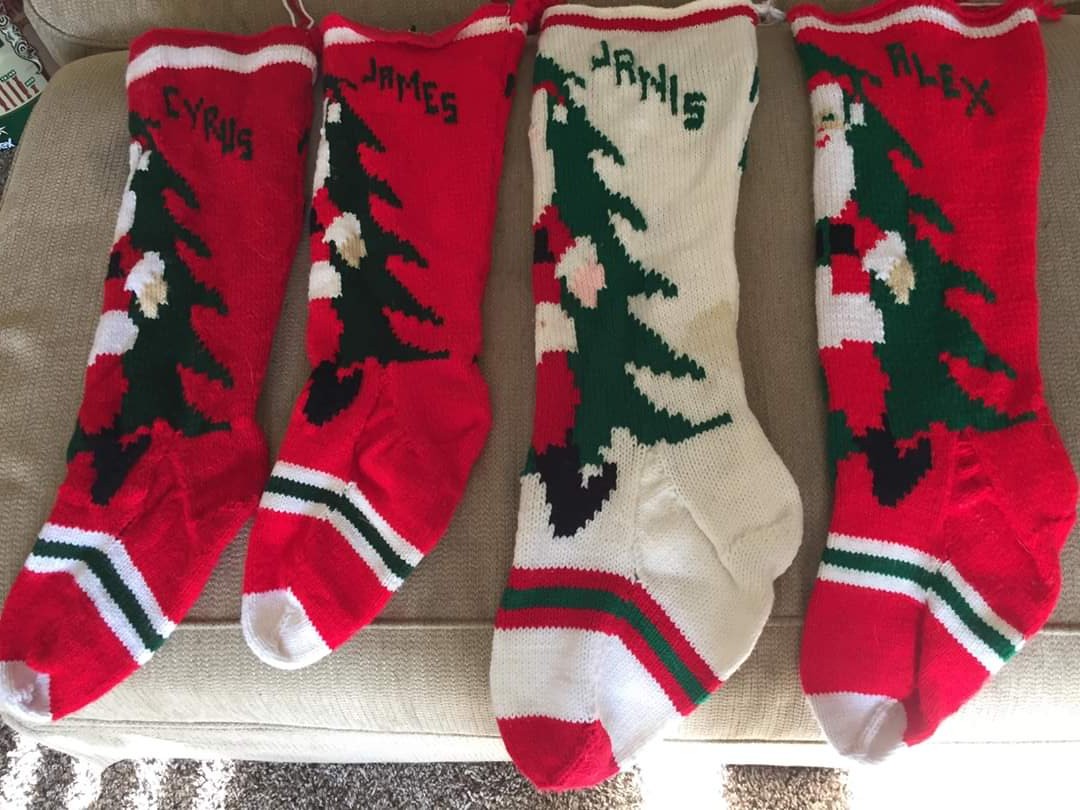
3 complete and 2 incomplete stockings

Printable Instructions

If you want a simple printable pattern, use this PDF for the instructions (Steps A-H) and this PDF for the image grid pattern (Steps A-B). 
 Find the 2-page PDF for the image grid pattern here
Find the 2-page PDF for the image pattern grid here

Find the 1-page PDF of the instructions here


Sarah digitized the pattern based on the 1940s grid pattern and notes that Grandma had hand written, and the new PDF pattern is at least 10 times easier to follow than the original pattern. Sarah added numbers that make it easier to follow. You can either print it in color or shade it in after printing it in greyscale to help remember which color to use. Message me if you would like a copy of the editable spreadsheet.

The 1940s pattern with grandma's handwritten instructions

More detailed instructions

Skills required: 
  • Knit stitch, purl stitch to make stockinette stitch
  • Knit two together
  • Mattress stitch
  • Duplicate stitch 
  • Crochet daisy chain for hanging loop

Materials:

-4 ply yarn (worsted weight = ordinary yarn)

I used Red Heart Super Saver. Get enough of each color to finish your stocking.
  • 2 ½ oz. Red (boy)/ White (girl)
  • ½ oz Green
  • ½ oz. White
  • ½ oz. Red 
  • Beige (Santa face, hands)
  • Black (belt- boots- face)


-Size #3 Needles
    • I like 2 sets of aluminum circular needles. 29 inches long.
    • If you like straight needles instead, you'll need 2 straight needles, 15 inches long, and 4-5 double pointed needles- 7 inches long

-Thread that matches to sew bias tape at top of stocking: Red (boy)/White (girl)

-Matching bias tape to keep the top from curling


-Small crochet hook for repairs, darning needle, 2-3 stitch holders, stitch marker
-Print pattern and image, add name to pattern, Draw 3" and 8" marks on your paper for the heel flap length and foot length, respectively.

Instructions:

A. Body:

  • Cast on 90 stitches (Gauge: 8 sts=1 inch from the pattern. I actually knit 6 sts = 1 inch). For this long-tail cast on I think I've been using about 5 feet of tail.


Instructions for long-tail cast on

    A basic idea of what each step looks like on the stocking
  • Follow image pattern until row 64. Each row in the pattern image is a double row: a knit row + a purl row.
Progress of the stocking body worked with straight needles. January 2017.


Notes on switching colors in the middle of rows:
  • Leave at least a 6 inch tail, you can weave ends in later (optional). The Kitchener/ toe Stitch video at the end of this post has a good demonstration of weaving in at the end of the video.
There are lots of ways to manage the tails of the many colors on the stocking. The clothes pins in the photo above are one method, as well as yarn bobbins, for tails shorter than 3 feet, I recommend pulling them out ever couple of rows to keep them from tangling too much. I'm about to try yarn bobbins for longer strands though.
Note about how much yarn is needed for each section: for my gauge (about 6 stitches per inch), I use about a foot of yarn for every 10 stitches in the pattern (double rows). For example, to do the red for Santa's left shoulder, there are 25 stitches, so I would need a minimum of 2.5 feet of working yarn, plus a foot for 6 inches of tail on either side. I would need at least 3.5 feet of red yarn for that section. Another example: The black belt has less than 64 stitches, so I would need a minimum of 6.5 feet + 1 foot tail = 7.5 feet of yarn. I would want a bobbin for this since it is more than 3 feet.

Grandma Kathleen recommends only stranding (carrying a piece of yarn across the back of your work between colors) when you have 3 or fewer stitches in between. For example, most of the letters, there's less than a 3 stitch gap between colors, but on the middle of the belt, there's a 6-stitch gap. On two of my stockings, stranding between those colors caused the middle of the belt to be raised, not flat.

The video below shows examples of stranding and how you can carry more than 3 stitches across the back of the work without too many problems. Sometimes I have floats that are 10 stitches long, but they are twisted in, as the video shows from 10:40-the end.


This video below shows how to twist new colors together so that they don't leave gaping holes, especially when there's a straight up/down color change.

B. Instep: (start with 72 stitches total)


  • 18 Stitches off each end to start the heel. You can place these on stitch holders or on a string of contrasting yarn, 36 stitches in the middle 
  • Stop pattern with 36 center stitches on one needle (row 73). You can put this on a long stitch holder if you'd like.

C. Heel:


  • Combine both 18 heel stitches on one needle for a total of 36 and K&P for 3” from bottom of tree
  • On last row of the 3 inches, P back for 20 stitches, P2 together, P 1,  and turn
  • K 6, K2 together, K 1, and turn
  • P 7, P2 together, P 1, and turn
  • K 8, K2 together, K 1, and turn
  • Continue until all of the stitches are used, about 15-20 rows, and 15-20 stitches across(?).

D. Gusset:


  • Pick up 23 - 30 stitches along the heel for the gusset on each side, depending on how much you want it to gather. More stitches will give more gathering. Fewer stitches will give a flatter appearance.
  • Divide all Heel & Gusset stitches on 2 needles (either straight or circular needles)
  • K&P, decreasing 1 stitch each side at next to last stitch of every row until even with front panel

E. Foot:

  • Put onto 3 double ended needles (1 each back side, 1 for front panel) (or 2 sets of circular needles)
  • Continue K around in a circle w/4th needle
  • Dec 1 st on each side of the foot every row until 18 sts on each underside needle
  • Then Knit stripe
    • 4 White (boy) / Red (girl)
    • 4 Green
    • 4 White  (boy) / Red (girl)
  • Continue to K red (or white for girl) until foot is 8” long from the back of the heel

F. Toe:


Dec4=K2tog at each end of front & sides of back

(1) Dec 4 st in row

(4-5) K 4 rows plain

(6) Dec 4 “”

(7-9) K3 rows

(10) Dec 4

(11-13) K3 rows

(14) Dec 4


COLOR CHANGE

Boy: *WHITE toe*
Girl: *RED toe*
(1-2) K2 rows plain

(3) Dec 4

(4-5) K2 rows plain

(6) Dec 4

(7) K1 plain
Lastly, Dec 4 every row at sides of toe until you have 16 stitches total (8 stitches/4 stitches/4 st’s)

G. Weave Toe: (using yarn needle. K&P indicate how to insert needle- Kitchener Stitch. Not normal K&P)

  • Front (instep) K – slide off
  • Front P – Keep on
  • Back P – Slide off
  • Back K – Keep on
Sometimes when I do this it looks fantastic. Other times it turns out like purl on the outside. Not sure what went wrong there.
  • Continue until the last stitch is on the needle. Then thread onto a sewing needle and push inside of the stocking and tie off. 
Here's an example of this:

H. Finishing:

  • Stitch eyes, nose, mouth onto Santa using the duplicate stitch, demonstrated in the video below

  • Darn together back halves of top & gusset sides with mattress stitch. The video below has the best demonstration of the mattress stitch I've seen from 2:20-9:25


  • Crochet the top loop
  • Sew matching bias tape to top of stocking to keep top from curling

The end!!! Congratulations. That's all.

Complete stocking except for bias tape at top


Tuesday, February 12, 2019

White Family Stockings: Origins


Christmas 2018. 2 generations of stockings.
In the 1950s, Grandma Kathleen started knitting Christmas stockings for her three children. She had no idea that it would become such a beloved tradition.

She already knitted 
some of Granddad Jerry’s socks, so it wasn’t anything new for her to do this too. When Aunt Peggy was about 13, she learned to make them too, and made stockings for Granny Jo, Grandma Kathleen, and Granddad Jerry, making three generations with the stockings.


Grandma Kathleen and Granddad Jerry's
stockings, made by teenage Aunt Peggy
Next, Aunt Peggy made stockings for her own children, Roger, Russ, Chris, and Jan. Uncle Brent liked the tradition, and learned to knit too. He made stockings for his kids too. Sarah was the first of those of my generation to start making the stockings, followed by Jan. They made stockings for their children too, making 5 generations of family with the stockings.

While teaching high school science during the 2008-2009 school year, I learned how to knit while attending a knitting group that a friend started. While visiting Aunt Peggy and Uncle Brent at Christmas 2009, I got introduced to the stocking. Aunt Peggy gave me knitting needles and yarn. I got off to a great start. After a while, I forgot what I was doing, and had to watch a few YouTube videos to get started again.

The record for fastest of the stockings was Cyrus': done in 4 days!
I really got stuck on the heel, but Aunt Peggy came down to help me mid-December 2018, and got me back on track. Right before Christmas 2018, nine years after beginning, I finally finished my own stocking. I finished Paul’s stocking a month later (1/22/19), and Ada’s stocking three weeks after that (2/10/19). It’s amazing what experience and dedication can do for a stocking.


Isn't that a fantastic stocking hanger?!
Working on the stocking makes me feel closer to the White/ Wallace side of the family. Thanks to the dedication of Aunt Peggy and Uncle Brent, what began as a craft of love by Grandma has blossomed into a dear tradition for five generations.

Bryan has started his own on the left.
Jo's on the right is the last Gentry stocking.
This post shows the background of the stocking. To see the pattern and instructions on how to make the stockings, see the next post.

Sunday, February 3, 2019

A Personal Story about Aunt Lethia Dunn

Here's a fun memory that Grandma Izzy had about her great aunt Lethia Dunn Primm:

"Delia’s sister, our Great aunt Lethia, had a “rawhead and bloody bones” in her attic so no one ever had courage enough to go further than halfway up those steps! She’d always have a huge bowl of biscuits and a bottle of syrup on her kitchen table which we dutifully stole, sticking our finger down in a biscuit, wiggling it back and forth, and pouring in syrup. Years later we learned she had a peep hole through which she gleefully watched us “steal” the stuff she’d made especially for us. Grandma Dunn was long dead by then."


Lethia is in the middle. Circa 1917.